
SECURITY & DIGITAL ASSET CUSTODY · 4 NOVEMBER 2026
The $6.34 Billion Binance Hack: Why Centralized Exchanges Will Always Be Targets—and Why Self-Custody Matters More Than Ever
As cryptocurrency adoption accelerates, the latest Binance security breach exposes a fundamental weakness in centralized digital-asset infrastructure. The message for investors is increasingly clear: use exchanges for trading, not necessarily for storing your wealth.
DCIN Editorial · Digital Currency Insider Network · November 4, 2026
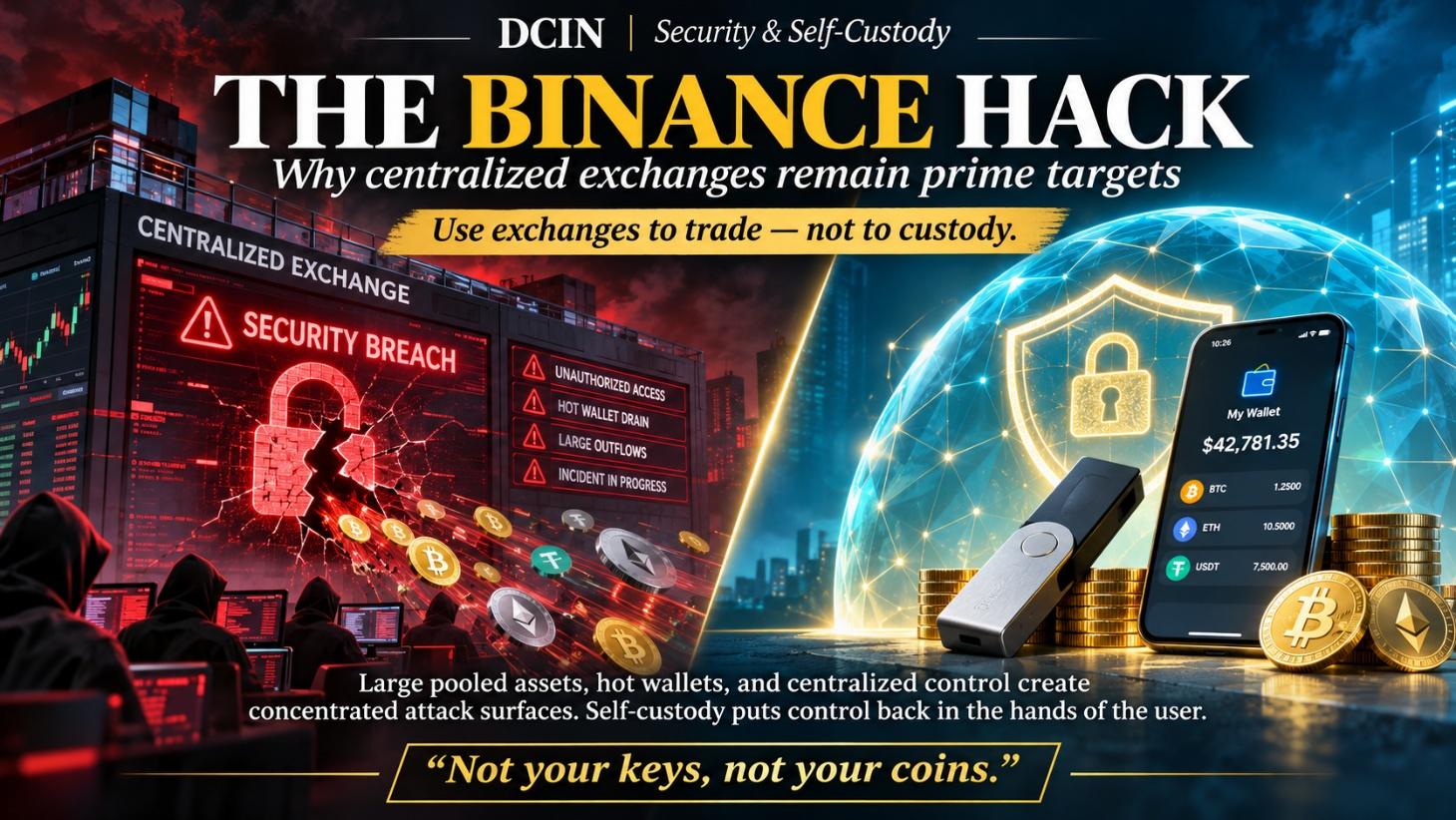
A $6.34 BILLION WAKE-UP CALL FOR THE CRYPTOCURRENCY INDUSTRY
On October 29, 2026, Binance, one of the world's largest cryptocurrency exchanges, experienced a massive security breach that resulted in approximately $6.34 billion in digital assets being compromised. The incident immediately reignited one of cryptocurrency's oldest and most consequential debates: Should investors trust centralized exchanges to hold their digital wealth, or should they maintain direct custody of their assets? According to Binance's November 3 preliminary findings, the attack affected its hot-wallet infrastructure. Binance initially indicated that a compromised DevOps engineer's laptop may have enabled attackers to access internal systems and submit unauthorized withdrawal transactions. The investigation had not yet established every technical detail.
Binance reported that approximately $2.85 billion in affected assets had been frozen or intercepted as of November 3. The company also announced that it would absorb the financial losses rather than pass them on to customers, using corporate resources and its Secure Asset Fund for Users (SAFU). By November 3, Binance said it had replenished approximately 98% of the affected token assets, with the remaining assets still being acquired.
Those are important commitments, and they distinguish the immediate impact on customers from the much larger amount of assets involved in the breach. But they do not eliminate the larger structural problem. The breach demonstrates that even a globally recognized cryptocurrency exchange with substantial technical resources, security personnel, insurance-like reserves, and sophisticated monitoring systems can still experience catastrophic vulnerabilities. The larger lesson is not simply that Binance was hacked. It is that centralized custody creates an enormous concentration of assets, operational control, and potential risk.
WHY CENTRALIZED EXCHANGES REMAIN ATTRACTIVE TARGETS
Centralized cryptocurrency exchanges have become essential infrastructure for the digital-asset economy. They provide liquidity, order books, fiat on-ramps, price discovery, asset conversions, and sophisticated trading functionality.
Platforms such as Binance, Coinbase, Kraken, and others have helped bring cryptocurrency to millions of individuals and institutions. But centralized exchanges also operate as massive repositories of digital wealth. When customers deposit cryptocurrency into an exchange's custodial account, the exchange generally controls the private keys associated with those assets. Customers receive account balances reflecting their claims, but they do not necessarily maintain direct cryptographic control of the underlying coins.
This arrangement creates a fundamental concentration of risk. A successful intrusion into an exchange's withdrawal systems, operational infrastructure, internal authorization procedures, or private-key management environment can potentially place enormous sums of digital assets at risk.
Hackers do not need to compromise millions of independent wallets when a single centralized operation may hold access to billions of dollars in customer and corporate assets. This is why centralized exchanges will likely remain high-value targets for organized cybercriminals and sophisticated state-sponsored actors. The financial incentives are simply too substantial.
THE INDUSTRY HAS SEEN THIS BEFORE
Binance's October 2026 incident is hardly the first major warning. In May 2019, Binance suffered a breach involving approximately 7,000 Bitcoin. The company reported that attackers used techniques including phishing and malware to obtain sensitive information, affecting its Bitcoin hot wallet.
Other cryptocurrency platforms have experienced major security failures over the years, including Mt. Gox, Coincheck, and Bybit. While the technical causes and customer outcomes differ substantially among these incidents, a common principle remains:
Concentrated digital-asset custody can create concentrated financial exposure. For cryptocurrency to mature into a genuinely global financial system, investors must consider not only whether the underlying blockchain is secure, but also who controls their assets and what happens when an intermediary fails.
THE CASE FOR SELF-CUSTODY: NOT YOUR KEYS, NOT YOUR COINS
One of Bitcoin's original philosophical contributions was the ability for individuals to maintain direct control over financial assets without relying on a conventional financial institution. That principle is often summarized in a familiar cryptocurrency expression:
"Not your keys, not your coins."
Self-custody means that the asset holder, rather than a centralized exchange, controls the private keys necessary to authorize blockchain transactions. These keys may be managed through a hardware wallet, a properly secured software wallet, or a more sophisticated multi-signature custody arrangement. Under this model, a cryptocurrency exchange does not have standing authority to move the user's independently held assets. If an exchange is breached, a properly isolated self-custody wallet is not automatically exposed simply because its owner has previously traded on that exchange. That is an important distinction.
Self-custody reduces dependence on an exchange's internal security infrastructure and financial solvency. However, it introduces different responsibilities. Lost recovery phrases, compromised devices, malicious smart-contract approvals, phishing attacks, and signing fraudulent transactions can still result in irreversible losses. Self-custody should therefore be understood as a transfer of control and responsibility—not an automatic guarantee of security. For investors prepared to implement appropriate safeguards, the ability to retain direct control of private keys is one of cryptocurrency's most valuable features.
A BETTER STRATEGY: USE EXCHANGES FOR TRADING, NOT LONG-TERM CUSTODY
Centralized exchanges provide valuable services, but investors should reconsider how they use them. There is a fundamental difference between using an exchange to execute a transaction and allowing an exchange to maintain ongoing custody of your entire digital-asset portfolio. A more security-conscious model involves holding long-term assets in a properly secured self-custody wallet and moving funds to an exchange only when necessary to execute a trade.
Once the transaction is completed, assets that do not need to remain on the trading platform can be withdrawn to a wallet controlled by the investor.
The principle is straightforward:
Store your assets in your own wallet. Connect or transfer to an exchange when you need to trade. Return assets to self-custody when the transaction is complete.
This approach reduces the amount of time assets remain exposed to exchange-level operational and custody risks. It does not eliminate transaction risks, and it is not necessarily suitable for every investor. Some individuals or institutions may be better served by regulated custodians with appropriate safeguards. Nevertheless, separating long-term asset storage from trading activity is a sound principle worth considering.
THE IDEAL DIGITAL-ASSET WORKFLOW
When interacting with decentralized exchanges, users should understand that connecting a wallet is not the same as authorizing the movement of assets. Approving a malicious smart contract can expose funds even when the private keys remain entirely under the wallet owner's control. For substantial holdings, a hardware wallet, secure backups, limited transaction permissions, and a separate wallet for higher-risk applications can provide additional protection.
THE HIDDEN RISK: YOUR ASSETS CAN BE FROZEN WITHOUT BEING STOLEN
The Binance incident highlights another important issue that deserves greater attention. An exchange does not necessarily have to lose customers' assets for those customers to lose immediate access to their funds. Following the October 2026 breach, Binance temporarily suspended withdrawals while conducting security checks. It subsequently worked to restore normal operations. Even if customers are ultimately reimbursed, a withdrawal suspension can prevent them from moving their assets during an important market event.
This is known as counterparty risk -- the possibility that another party's financial condition, cybersecurity failure, operating procedures, or legal obligations could interfere with an investor's access to assets.
For long-term cryptocurrency holders, that risk should be considered alongside price volatility. An investor may correctly predict the market and still encounter difficulties if an intermediary restricts access to funds. Self-custody removes the exchange from the ongoing custody relationship, although blockchain congestion, token issuer controls, and other protocol-level restrictions can still affect transfers.
SECURITY MUST BECOME PART OF THE DIGITAL-ASSET OWNERSHIP MODEL
As the digital-asset industry expands, security will become increasingly important to mainstream adoption. Cryptocurrency exchanges will continue to invest billions in cybersecurity, internal controls, monitoring systems, wallet protection, and financial reserves. These investments matter. But cybersecurity is an ongoing contest between defenders and increasingly sophisticated attackers.
The latest Binance breach also demonstrates the growing complexity of attacks involving software-development environments, compromised employee devices, social engineering, and internal authorization systems.
In its November 3 investigation update, Binance reported rebuilding affected wallet infrastructure and an internal AI tool, replacing compromised devices, strengthening access controls, and commissioning an independent cybersecurity review.
These measures illustrate how modern digital-asset security extends far beyond protecting a private key. An organization must also secure every system and individual authorized to initiate, approve, or facilitate transactions. For users, the same principle applies on a smaller scale.
Owning a self-custody wallet means taking responsibility for device security, recovery phrases, transaction verification, malicious links, software updates, and smart-contract permissions. The goal is not simply decentralization for its own sake. The goal is reducing unnecessary points of failure while preserving control over digital wealth.
THE FUTURE OF CRYPTO IS OWNERSHIP, NOT DEPENDENCE
Blockchain technology was created in part to make direct digital ownership possible. Yet much of today's cryptocurrency-economy still operates through centralized intermediaries that resemble the financial institutions blockchain was originally intended to supplement or bypass.
There is an important role for these intermediaries. Centralized exchanges provide liquidity, market access, customer services, fiat conversion, and other functions essential to a functioning digital-asset economy. But trading infrastructure and asset custody do not have to be the same thing. The industry can evolve toward a model in which investors retain direct ownership of their assets while using exchanges, decentralized protocols, and other financial services only when necessary.
That model would preserve many of the benefits of centralized financial infrastructure while reducing prolonged exposure to its custody risks. For sophisticated investors and institutions, this may increasingly involve combinations of hardware wallets, multi-signature authorization, segregated vaults, qualified custodians, and programmable transaction permissions. For everyday investors, it may begin with something as simple as learning how to securely operate a self-custody wallet.
CONCLUSION: THE BINANCE HACK SHOULD CHANGE HOW INVESTORS THINK ABOUT CUSTODY
The October 29 Binance breach should become a defining moment in the discussion of digital-asset security. Approximately $6.34 billion in assets were affected in an incident involving one of the world's most prominent cryptocurrency exchanges. Binance has committed to covering customer losses, and its recovery efforts demonstrate the importance of substantial financial reserves and coordinated incident response. But the central question remains unanswered by reimbursement alone.
Why should an individual who intends to hold cryptocurrency for years leave those assets continuously exposed to the operational systems of a trading platform? For investors capable of securely managing their own private keys, there is a compelling alternative. Maintain direct custody of long-term holdings. Use exchanges for their intended purpose: accessing markets and executing transactions. Move only the amounts necessary for trading. And once trading is complete, return assets to secure storage.
Not every investor should take on self-custody responsibilities without adequate preparation. But every investor should understand the distinction between owning digital assets and depending on someone else to safeguard access to them. The cryptocurrency industry has spent more than fifteen years advancing the concept of decentralized financial ownership. Perhaps it is time for the behavior of cryptocurrency investors to reflect that original vision. The next evolution in digital finance should not merely be about which exchange offers the lowest fees or greatest liquidity. It should be about who actually controls the assets. And for those who choose self-custody, the answer is simple:
Your wallet. Your keys. Your assets.
DCIN Editorial | Digital Currency Insider Network
Published November 4, 2026
Sources: Binance official security disclosures, November 3, 2026; Reuters reporting, November 3, 2026; Binance historical security disclosures. This article is general educational commentary, not individualized financial or cybersecurity advice.
Publisher's note: The October 2026 investigation remains subject to further findings. Approximately $6.34 billion refers to the reported value of affected assets, while Binance's reported recovery, freezing, and replenishment figures are separate measures and should not be added together.
Sources & attribution
DCIN Editorial · Digital Currency Insider Network · November 4, 2026