RESEARCH & MARKETS · OCTOBER 2026
The Great Transformation of Real Assets
Why inflation, Bitcoin and tokenization could reshape global finance - and turn real-world wealth into digital collateral.
Digital Currency Insider Network · Research & Markets Desk · October 2026
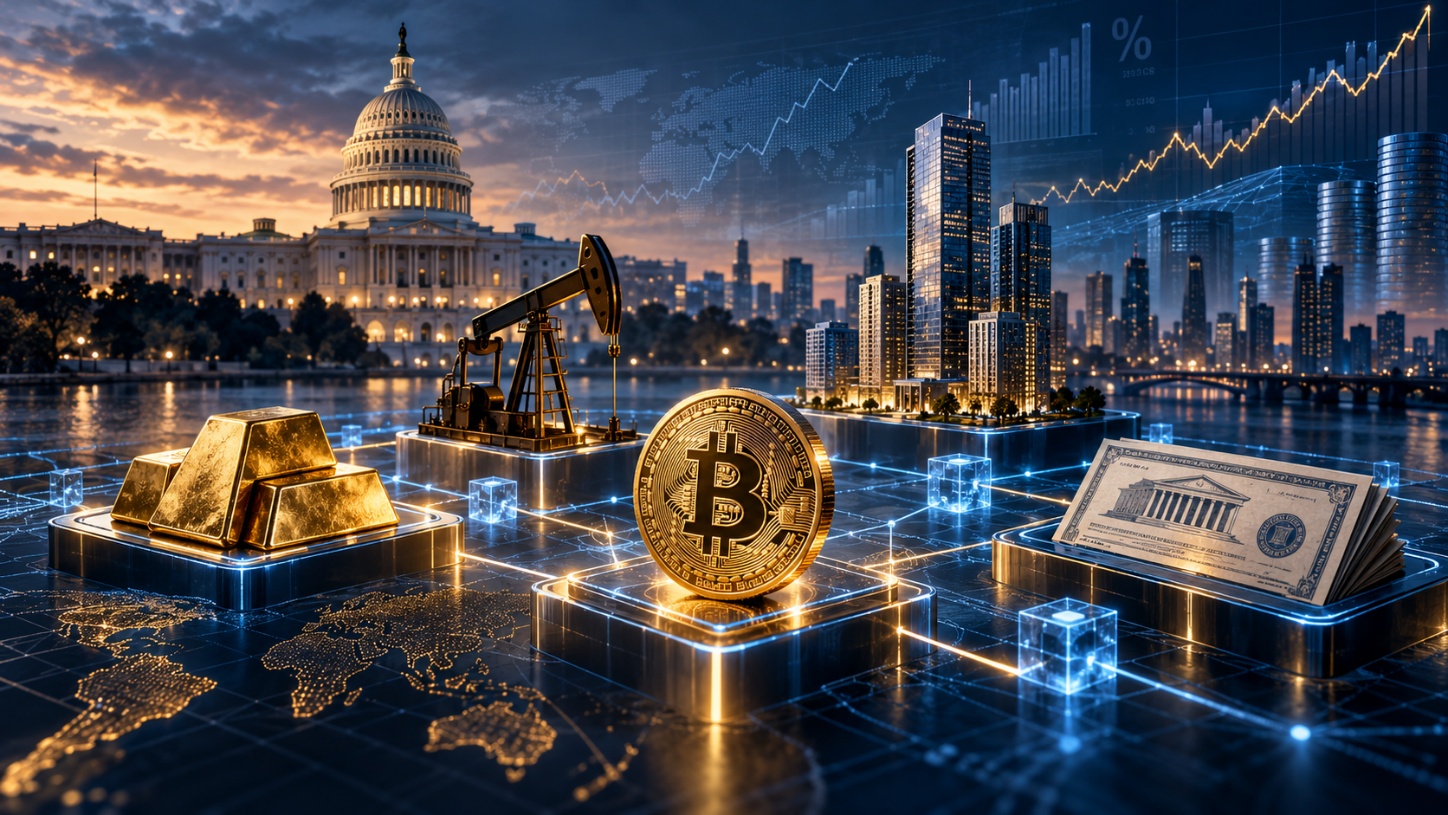
For decades, the global financial system has revolved around one dominant idea: money sits at the center, while assets orbit around it. That relationship may now be changing. Persistent government debt, elevated borrowing costs, inflation concerns and the rapid development of blockchain-based financial infrastructure are creating the conditions for something potentially much larger than another cryptocurrency cycle. The next major transformation in finance may be the digitization of real-world wealth itself. Gold. Oil. Real estate. Government securities. Private credit. Commodities. Infrastructure. Receivables. Mineral and/or hydrocarbon (oil & natural gas) rights.
Rather than existing exclusively inside vaults, brokerage accounts, banks, clearing systems and paper contracts, these assets can increasingly be represented digitally through tokenization. And if investors become more concerned about the long-term purchasing power of money, the combination of scarce assets + blockchain rails could prove especially important.
The Debt and Inflation Equation
At the heart of the argument is a basic economic tension. High interest rates can help suppress inflation by making borrowing more expensive and reducing demand. But higher rates also increase financing costs throughout the economy - including the cost of servicing government debt. The Federal Reserve itself warned in its May 2026 Financial Stability Report that persistently higher interest rates and inflation could raise debt-servicing costs for governments and businesses and increase financial vulnerabilities.
As of October 2026, the Federal Reserve's target federal funds range stands at 3.75% to 4.00%, while the Fed reports year-over-year PCE inflation at 3.4% for August 2026. This creates a difficult balancing act. Keep rates high for too long, and debt becomes increasingly expensive to refinance. Cut rates too aggressively, and inflation could reaccelerate. Neither outcome is guaranteed. Nor should investors assume governments simply inflate their debts away. Higher inflation can cause bond investors to demand higher yields, potentially increasing borrowing costs rather than reducing them. But the tension itself is important. Because when investors become concerned that currency may lose purchasing power over time, they frequently begin looking beyond cash. That is where scarce and productive assets enter the discussion.
Bitcoin: Digital Scarcity
Bitcoin introduced something fundamentally unusual into modern finance: a globally transferable digital asset with a predetermined maximum supply. Unlike a fiat currency, Bitcoin cannot simply be issued in unlimited quantities in response to fiscal or monetary requirements. That makes Bitcoin's investment thesis fundamentally different from the dollar. The argument is straightforward: If the quantity of currency and credit expands over time while the supply of an asset remains constrained, investors may increasingly value the scarce asset as an alternative store of wealth. That does not mean Bitcoin is guaranteed to appreciate. Bitcoin remains highly volatile and sensitive to liquidity, leverage, regulation, market psychology and broader risk conditions. But its scarcity mechanism explains why Bitcoin has increasingly entered the same monetary conversation historically occupied by gold. Bitcoin demonstrated that scarcity could exist digitally. Tokenization may demonstrate that physical scarcity can become digital as well.
Gold Goes On-Chain
Gold has represented stored wealth for thousands of years. Its problem has never been scarcity - its problem has been infrastructure, transparency and validation. Physical gold must be mined, refined, transported, authenticated, insured, stored and ultimately transferred. Blockchain technology provides another possibility. A kilogram of vaulted gold does not need to be physically divided into a thousand pieces for a thousand investors to hold fractional economic interests in it. Instead, ownership or beneficial interests can potentially be represented by digital tokens. The critical distinction, however, is that the token itself is not the gold. A credible structure requires an enforceable bridge between the digital instrument and the physical asset: Token → legal ownership right → identified gold → qualified custody → independent verification → defined redemption rights.
Without that chain, the words "gold-backed token" may mean very little. With it, physical gold potentially becomes divisible, transferable and programmable financial collateral. That distinction could become one of the defining issues of the RWA market.
Oil: From Barrel to Digital Financial Asset
Oil presents an even more complex opportunity. A barrel of oil is simultaneously a physical commodity, a globally traded financial asset and the economic foundation behind enormous portions of the world's industrial infrastructure. Tokenization could potentially represent numerous different interests related to petroleum.
A token might represent:
ownership of produced oil held in storage;
rights under a warehouse receipt;
contractual entitlement to future production;
royalty interests;
revenue participation from producing wells;
financing claims against commodity inventories; or
securities backed by appropriately structured energy assets.
These structures are materially different from simply creating an "oil token." The value must come from an enforceable claim against something economically real. And this is where blockchain's role becomes more interesting. A producing oil asset generates economic activity. Tokenization could make portions of that economic activity easier to divide, finance, transfer and potentially pledge as collateral. The same principle could eventually be applied to natural gas, copper, silver, lithium, agricultural commodities and other natural resources.
The Rise of the RWA Economy
The important point is that Real World Asset tokenization does not require inventing an entirely new asset class. In many cases, tokenization simply creates a new digital representation of something that already exists.
BlackRock describes tokenized funds as assets in which ownership is represented digitally on blockchain infrastructure. The company says the two categories currently achieving the clearest product-market fit are stablecoins and tokenized Treasury funds. BlackRock reports that tokenized Treasury funds have surpassed $15 billion in market capitalization, while stablecoins are around the $300 billion level.
This is significant because institutional finance is moving beyond theoretical pilots. In April 2026, BlackRock, Standard Chartered and OKX announced a framework allowing qualified institutional clients to use BlackRock's tokenized BUIDL Treasury fund as collateral while trading, with Standard Chartered providing regulated off-exchange custody.
That represents an important evolution. The tokenized asset is no longer simply something investors hold. It becomes something investors can use.
From Investment to Collateral
This may eventually prove to be the most transformative element of tokenization. Traditional finance depends heavily on collateral.
Treasury securities collateralize loans.
Real estate collateralizes mortgages.
Inventory backs working-capital financing.
Receivables can be financed.
Securities support margin accounts.
What happens when those assets become digitally represented and programmable? Imagine an investor holding $1 million of verified tokenized gold. Rather than selling the gold to obtain liquidity, the investor could potentially pledge the tokenized position as collateral and borrow against it.
Now extend the principle:
Tokenized Treasury → collateral
Tokenized gold → collateral
Tokenized real estate → collateral
Tokenized commodity inventory → collateral
Tokenized receivable → collateral
Tokenized energy revenue → collateral
At that point, blockchain is no longer merely a place where assets are traded. It becomes part of the global collateral infrastructure. BlackRock's BUIDL is already moving in this direction. It has been accepted in collateral arrangements involving major digital trading platforms, and its 2026 integration with Standard Chartered and OKX demonstrates how tokenized securities can operate within institutional margin and liquidity systems.
The Digital Balance Sheet
This leads to a much bigger concept. The financial wallet of the future may not simply contain cryptocurrency. It could contain an entire balance sheet.
An investor will eventually hold:
Digital cash: stablecoins
Government debt: tokenized Treasuries
Gold: vaulted-gold tokens
Energy: tokenized oil or production interests
Property: tokenized real estate
Credit: tokenized loans or receivables
Equities: blockchain-based securities
Bitcoin: digitally scarce reserve asset
All inside interoperable financial infrastructure. That vision moved another step forward in October 2026 when Securitize announced blockchain-based access to 1:1-backed U.S. equity interests for eligible investors, initially covering companies including Apple, Microsoft, Nvidia, Alphabet, Tesla, Amazon and others. Meanwhile, BlackRock expanded tokenized money-market products during August 2026, further demonstrating that major asset managers increasingly view blockchain as financial infrastructure rather than simply cryptocurrency technology.
The Opportunity for Resource-Rich Nations
The implications may be particularly significant for emerging and resource-rich economies. Many countries possess enormous quantities of oil, minerals, agricultural production, land and other natural resources while simultaneously facing limited access to efficient international capital markets.
Historically, financing may require numerous layers: Resource owner → government → bank → intermediary → commodity trader → international financing institution → investor.
Tokenization raises the possibility of another model: Verified resource → legally structured asset → digital token → compliant marketplace → global capital.
That does not eliminate regulators, banks, securities laws, commodity laws or sovereign authority. Nor should it. But it could reduce friction and create new financing structures around assets that previously were difficult to fractionalize or distribute globally. For resource-rich developing economies, the long-term significance could be enormous. Instead of relying exclusively on sovereign borrowing, a country or private-sector operator could potentially finance specific productive assets through transparent, legally structured digital instruments tied to identifiable economic value.
The distinction is critical. It is not about "putting a country's natural resources on crypto." It is about creating regulated financial instruments around defined rights to real economic assets.
The Verification Problem
This is also where the RWA industry will either establish credibility - or lose it. Saying: "This token is backed by gold" is not enough. Neither is: "This token represents oil reserves." Investors need to know exactly what they own.
For gold: Who owns the metal? Where is it stored? Is the bar identified? Who audits it? Can the investor redeem the token? What happens if the issuer fails?
For oil: Who owns mineral rights or subsurface right to the hydrocarbons? Are the reserves proved, probable or prospective? Who controls production? What royalties and taxes rank ahead of investors? Who receives the oil-sale proceeds? What legal entity issues the token? What does one token legally entitle its holder to receive?
Blockchain can verify that a token exists. It cannot, by itself, prove that the underlying asset exists or that the token holder has enforceable rights against it. That bridge between digital record and legal reality is where the serious RWA industry will be built.
Bitcoin Was Only the Beginning
Cryptocurrency's first major breakthrough was proving that value could move globally without relying entirely upon traditional financial rails. Stablecoins demonstrated that fiat currency could move using similar technology. Tokenized Treasuries demonstrated that conventional securities could follow. The next stages could bring increasingly complex assets onto the same infrastructure. The progression may ultimately look something like this:
Bitcoin → Stablecoins → Tokenized Treasuries → Tokenized securities and funds → Gold and commodities → Real estate and private credit → Energy and infrastructure → Natural resources and sovereign assets
Not every asset belongs on-chain. Not every tokenization project will succeed. And regulation, custody, valuation, liquidity and enforceability remain significant challenges. But the direction of travel is increasingly difficult to ignore.
From Tokenization to the Digitization of Wealth
The most important mistake investors could make may be viewing RWA tokenization as simply another branch of cryptocurrency. It is potentially much larger. The underlying proposition is not: "Let's create more tokens." It is: "Let's allow real economic assets to exist inside modern digital financial infrastructure."
That means a gold bar remains gold. A barrel of oil remains oil. A Treasury remains a Treasury. A building remains real estate. What changes is the infrastructure through which ownership, financing, collateral and settlement occur. And if the coming decade is defined by sovereign debt pressure, inflation concerns, changing monetary systems and increasing demand for tangible stores of economic value, then the convergence of hard assets and blockchain infrastructure could become one of the most important financial developments of the period. Bitcoin showed the world that digital scarcity was possible. Real World Asset tokenization may show the world that real wealth can become digital without ceasing to be real.
From the Digitization of Wealth to Democratizing of Wealth
While the great transformation ushers in movement of taking physical value and turning it digital: "Let's allow real economic assets to exist inside modern digital financial infrastructure." And "Let's allow everyday citizens to access this wealth creation and appreciation."
DCIN Editorial Note: This article is for informational and educational purposes and does not constitute investment, legal, tax or financial advice. Tokenized assets may constitute securities, commodities or other regulated financial instruments depending on their structure and jurisdiction. Investors should independently verify asset ownership, custody, valuation, legal enforceability and regulatory status before participating in any RWA offering.
© 2026 Digital Currency Insider Network — DCIN
Sources & attribution
Digital Currency Insider Network · Research & Markets Desk · October 2026