
DCIN RESEARCH HUB | AI, CRYPTO & ENERGY · OCTOBER 2026
AI-Linked Crypto Workflows & Infrastructure
The Coming Collision of Artificial Intelligence, Blockchain and America’s Power Grid
Supplied AI-Linked Crypto Workflows & Infrastructure article · October 2026
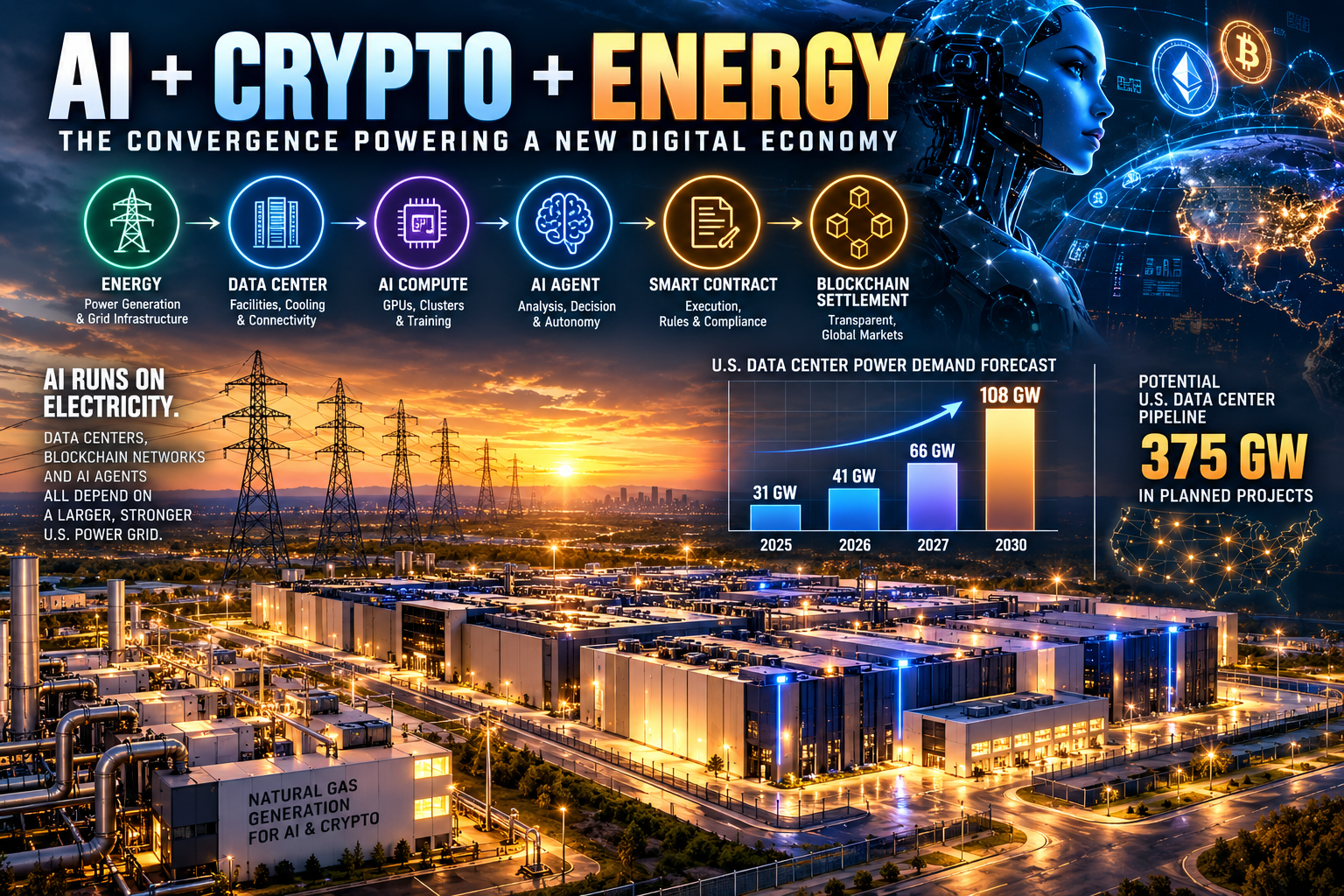
Artificial intelligence and cryptocurrency are entering a new phase of convergence. For much of the past decade, AI and blockchain developed along largely separate tracks. Artificial intelligence focused on data, machine learning and centralized cloud computing. Blockchain focused on decentralized finance, digital assets, smart contracts and distributed networks.
That separation is beginning to disappear. AI agents are increasingly being developed to analyze markets, interact with smart contracts, execute transactions and manage digital-asset portfolios. At the same time, decentralized physical infrastructure networks - often called “DePINs” - are creating blockchain-based markets for bandwidth, data, storage and computing resources needed by AI. Behind all of this sits a much larger physical constraint: Electricity.
The next stage of the AI economy will not be determined only by better algorithms, faster chips or smarter autonomous agents. It will increasingly depend upon whether enough power can be generated, transmitted and delivered to the data centers where these systems operate. And nowhere is that challenge becoming more significant than in the United States.
From Smart Contracts to AI Agents
Smart contracts were one of blockchain's first major innovations because they allowed financial and commercial rules to execute automatically once predetermined conditions were met. Artificial intelligence potentially adds another layer. Instead of a person manually deciding when to interact with a smart contract, an AI agent can continuously evaluate information, formulate a decision and initiate an on-chain action. Potential workflows include: Market analysis → AI decision → risk check → smart contract → blockchain settlement.
An agent might monitor interest rates across decentralized lending protocols, evaluate liquidity and collateral conditions, move assets between approved strategies and rebalance the portfolio—all without requiring a human to manually initiate every transaction. Similar systems could ultimately handle treasury management, collateral optimization, stablecoin liquidity, commodity-token settlement, insurance triggers, carbon-credit markets and tokenized real-world assets.
Research suggests, however, that the sector is still immature. A 2026 study of AI investment agents found considerable experimentation but limited evidence that many purported autonomous systems were actually performing sophisticated autonomous trading. Another 2026 study proposed cryptographic policy controls designed to prevent AI agents from translating malicious instructions or prompt injections directly into blockchain transactions. That distinction is important. The future is unlikely to be an AI system simply receiving unrestricted access to a wallet. More realistically, financial AI agents will operate within machine-readable authorization boundaries - transaction limits, approved protocols, permitted assets, maximum exposures, multi-signature requirements, simulations and human override mechanisms. Blockchain could therefore become something particularly valuable to autonomous AI: a verifiable execution and accounting layer.
AI provides intelligence and decision-making. Smart contracts provide deterministic rules. Blockchain provides settlement, ownership records and an auditable transaction history.
Crypto Is Also Becoming Infrastructure for AI
The relationship works in the opposite direction as well. Blockchain networks are increasingly being used to organize and compensate the physical resources AI requires. Consider GRASS, one of the more visible examples. Grass describes itself as a decentralized network through which participants contribute unused internet bandwidth to help collect publicly accessible web information used in AI data pipelines. The organization says its network includes millions of participating residential connections and is expanding from training-data collection toward live information retrieval for AI systems.
In October 2026, Grass launched a Contents API intended to turn public web pages into model-ready information, explicitly positioning that infrastructure for AI models and agentic applications that require access to current web information. This illustrates an important evolution of crypto. The blockchain industry is moving beyond simply creating digital currencies. Tokenized networks can create economic incentives for people or companies to contribute real resources: bandwidth, data, storage, GPUs, connectivity, electricity and eventually specialized computing capacity. Instead of one corporation owning every component of the infrastructure stack, decentralized networks can potentially aggregate resources belonging to thousands or millions of independent participants. AI may become one of the largest customers for that infrastructure.
But AI Ultimately Runs on Electricity
The software story is impressive. The electricity numbers are even more consequential. An August 2026 U.S. data-center project analysis identified approximately 1,733 planned projects representing roughly 375 GW of potential additional capacity, although not every proposed facility will ultimately reach construction or operation. The same analysis highlights the enormous difference between projects proposed and facilities actually capable of being connected to the grid. Approximately 831 new U.S. data centers were reported under construction, while narrower construction tracking identified 94 major projects expected to begin construction during 2026.
Electricity availability is becoming the gating factor. Goldman Sachs estimated in May 2026 that U.S. data-center power demand could increase from approximately 31 GW in 2025 to 41 GW in 2026 and 66 GW in 2027. That would mean data-center demand more than doubling in just two years. Scheduled data-center capacity additions alone were estimated at 13.6 GW during 2026 and another 36.3 GW in 2027. By September, Goldman Sachs had increased its longer-term outlook further, estimating U.S. data-center power demand could reach approximately 108 GW by 2030. Lawrence Berkeley National Laboratory reaches the same conclusion from another direction. Its 2025 U.S. Data Center Energy Usage Report update estimates that data centers could consume approximately 11.8% of total U.S. electricity by 2030, with modeled scenarios ranging from 9.5% to 15.3%. Those numbers fundamentally change the conversation. The AI race is rapidly becoming an energy infrastructure race.
100 MW Is No Longer an Extraordinary Request
Traditional commercial buildings may measure electrical requirements in kilowatts or a handful of megawatts. AI campuses increasingly discuss power in hundreds of megawatts. Large campuses can contemplate 500 MW, 1 GW or greater ultimate buildouts.
For perspective, a continuously operating:
100 MW facility consumes 2.4 GWh every day
500 MW facility consumes 12 GWh every day
1 GW facility consumes 24 GWh every day
A single 1 GW AI campus therefore behaves less like an ordinary commercial customer and more like a major industrial load center. And AI facilities are particularly demanding because electricity is only part of the requirement. Operators also need transmission infrastructure, substations, transformers, cooling systems, backup generation, water or alternative cooling technologies, fiber connectivity and extremely high reliability.
Goldman Sachs reported in October 2026 that the bottleneck has expanded beyond GPUs and computing hardware to include grid infrastructure, transmission, interconnection queues, permitting, equipment, water and skilled labor. Its latest research expects global data-center electricity demand to rise approximately 170% between 2025 and 2030, with more than 60% of that growth coming from the United States. Some U.S. grid interconnection waits are now measured in years rather than months. That creates an extraordinary economic opportunity for one sector in particular:
energy producers capable of bringing generation directly to the load.
Behind-the-Meter Generation Could Become Part of the AI Buildout
The traditional model is straightforward: Build the data center → connect to the utility → purchase electricity from the grid. The emerging model could be significantly more complex: Data center + grid connection + dedicated generation + batteries + microgrid + backup generation.
In some locations, developers may have access to natural gas wells, pipelines or otherwise underutilized gas resources that could support distributed generation. A useful natural-gas conversion illustrates the opportunity. Approximately one Mcf of natural gas contains roughly 304 kWh of thermal energy. At approximately 35% electrical efficiency, a natural-gas reciprocating generator can produce around 106 kWh of electricity per Mcf.
At that efficiency, a well producing 50 Mcf per day supports only roughly 220 kW of continuous electrical generation. Scaling upward therefore requires substantial gas supply: the economics of a 100 MW or 1 GW AI campus are dramatically different from powering a small crypto-mining container or edge-compute installation. Using that conversion as a planning approximation, continuous generation would require on the order of:
100 MW — approximately 22.6 MMcf of natural gas per day
500 MW — approximately 113 MMcf per day
1 GW — approximately 226 MMcf per day
before accounting for generator derating, parasitic loads, compression, gas treatment, maintenance and redundancy. Gas quality, pressure, CO₂, nitrogen, H₂S, ambient conditions and auxiliary loads can all reduce actual electrical output. This is why the opportunity extends beyond simply installing generators. Large AI campuses may create demand for an entirely new category of integrated energy development encompassing gas production, gathering, processing, generation, substations, batteries, microgrids and data-center infrastructure.
Case Study: Elon Musk’s Colossus Shows What the AI Energy Race Looks Like
Perhaps no project demonstrates the scale of the emerging AI-energy economy better than Elon Musk’s Colossus supercomputing complex in the greater Memphis, Tennessee–Southaven, Mississippi region. Originally developed by xAI to power Grok and now operating within SpaceXAI, Colossus has rapidly evolved from a single AI supercomputer into a multi-site hyperscale computing and energy complex.
SpaceXAI says it intends to equip its Memphis infrastructure with approximately 1 million GPUs, an extraordinary concentration of computational capacity. The broader development is being expanded toward approximately 2 gigawatts of compute and supporting power capacity. To understand the scale, 2 GW is 2,000 megawatts. A facility operating continuously at that level would consume approximately: 48 GWh of electricity every day or approximately: 17.5 TWh per year at full continuous load. That is no longer a conventional data-center electricity requirement. It begins to resemble the power demand of a substantial metropolitan area or major heavy-industrial complex.
Musk Is Effectively Building Energy Infrastructure Alongside AI Infrastructure
The most important aspect of Colossus may not be the GPUs. It may be how xAI has approached electricity. Rather than waiting exclusively for conventional utility infrastructure to be expanded, the company deployed substantial quantities of temporary natural-gas generation to accelerate development of its computing capacity. The company is now constructing a 1.2 GW permanent power plant in Mississippi to support the broader computing complex.
That is an extraordinary development. An AI company is no longer simply purchasing servers and leasing space inside a data center. It is effectively developing: AI compute + data-center infrastructure + natural-gas generation + grid infrastructure + battery storage + cooling + water systems as one integrated industrial platform. Colossus therefore provides a glimpse into how the next generation of hyperscale AI campuses may be developed.
A Massive Battery Behind the Compute
The campus also illustrates the growing importance of energy storage. Satellite analysis published in 2026 identified approximately 720 Tesla Megapacks at the Colossus 2 complex. Depending upon the Megapack configuration, that installation could represent roughly 2.8 GWh of battery storage and potentially hundreds of megawatts to more than one gigawatt of instantaneous battery output. A battery system of that magnitude can perform several functions simultaneously:
smooth sudden changes in AI computing demand,
provide power during grid interruptions,
stabilize dedicated generation,
reduce peak grid withdrawals;
and bridge the transition between utility power and on-site generation.
The result begins to look less like a traditional data center and more like an independently managed industrial microgrid built around artificial intelligence.
Colossus Demonstrates Why the Power Question Comes First
The significance of Musk's development extends well beyond xAI. It provides a real-world demonstration of the central challenge facing America's AI buildout.
You can acquire land.
You can purchase GPUs.
You can construct data halls.
But if hundreds of megawatts—or eventually gigawatts—of reliable electricity cannot be delivered to the site, those assets cannot operate.
Colossus demonstrates one potential solution: build the power infrastructure at the same time as the computing infrastructure. That approach could fundamentally change data-center development across the United States. Future AI campuses may increasingly be evaluated not simply by available acreage and fiber connectivity, but by access to: natural gas, electrical generation, transmission, substations, batteries, water and fiber.
In that environment, energy-rich locations could become some of the most valuable digital-infrastructure locations in America. Colossus may therefore be remembered not simply as one of the world's largest AI supercomputers. It may be remembered as one of the first examples of the emerging AI power campus - where computing and electricity generation are designed as parts of the same system.
Crypto Mining May Have Created the Prototype
There is an interesting precedent. Bitcoin and other proof-of-work mining operations spent years learning how to locate computing equipment directly beside inexpensive electricity. Some miners deployed beside hydroelectric plants. Others located near oil and natural-gas production. Others negotiated demand-response agreements in which computing loads could be reduced when the electrical grid needed power elsewhere.
AI computing is technically different. A Bitcoin ASIC cannot simply be converted into an AI GPU, and an AI training cluster generally requires far greater networking sophistication and reliability than a shipping container filled with cryptocurrency miners. But crypto mining demonstrated an important concept: Compute does not always have to wait for the grid. Compute can go to the energy. That principle may become increasingly valuable to AI. Developers could begin identifying locations where energy, land and fiber are available first—and bring computing infrastructure to those resources.
The AI-Crypto Infrastructure Stack
The result is the beginning of a new digital infrastructure architecture. At the upper layer are AI agents, analyzing information and making decisions. Underneath them are blockchain networks and smart contracts, establishing ownership, permissions, transactions and settlement. Supporting those systems are decentralized infrastructure networks providing data, bandwidth, storage and compute. Beneath all of them are data centers and GPU clusters. And beneath everything else is the resource without which none of it functions: energy. The complete emerging stack could look like this: Energy → Data Center → Compute → Data → AI Agent → Smart Contract → Blockchain Settlement → Tokenized Economy That is far broader than either "AI" or "crypto" considered independently. It represents the creation of an increasingly machine-operated economic infrastructure.
Electricity Could Become the Scarce Digital Asset
For years, discussions about digital infrastructure revolved around semiconductor availability. The next bottleneck may increasingly be measured in megawatts. EIA now identifies data-center development as a major contributor to rising U.S. electricity consumption. It expects U.S. electricity sales to reach approximately 4,135 billion kWh in 2026 and 4,211 billion kWh in 2027, with rapid growth in commercial demand. The Department of Energy similarly recognizes data centers and AI as major drivers behind the return of significant electricity-demand growth in the United States. Not every proposed data center will be built. In fact, that is precisely the point. The winners may increasingly be the projects that can answer a simple question before construction begins: Where will the electricity come from?
The U.S. data-center development pipeline already faces constraints from electricity availability, interconnection, permitting, zoning and water. As AI consumption grows, access to firm power could become as strategically important as access to GPUs. Natural gas generation, renewable generation, nuclear power, battery storage, microgrids and other behind-the-meter systems therefore should not be viewed merely as supporting industries to artificial intelligence. They are becoming part of the AI industry itself.
The Convergence Is Just Beginning
Artificial intelligence may eventually allow software agents to operate portions of the digital economy autonomously. Blockchain can give those agents a programmable financial and settlement infrastructure. Decentralized networks can provide some of the data, bandwidth, storage and computational resources they consume. But the entire system ultimately rests on physical infrastructure:
Servers require buildings.
GPUs require cooling.
Networks require fiber.
And intelligence requires electricity.
The most important investment question surrounding the AI-crypto convergence may therefore not be which token, model or blockchain wins. It may be:
Who controls the infrastructure underneath them?
The companies, energy producers, utilities, data-center developers and decentralized networks that can reliably connect energy, compute, data and digital settlement may ultimately occupy the most valuable position in the emerging AI economy. Because in the next phase of digital finance, energy will not simply power the network.
Energy will be part of the network.
Sources & attribution
Supplied AI-Linked Crypto Workflows & Infrastructure article · October 2026