
DCIN RESEARCH HUB | INAUGURAL RESEARCH FEATURE · 21 OCTOBER 2026
The Rise of Tokenization
From Experiments to Institutional Infrastructure: How Tokenization Went from the Edge of Finance to a Multitrillion-Dollar 2030 Opportunity
Digital Currency Insider Network - Research Hub · October 21, 2026
Executive Summary
At the beginning of this decade, tokenization was still largely an experiment. Banks ran proofs of concept. Blockchain companies spoke about putting real estate on-chain. Security-token startups promised fractional ownership of everything from buildings to artwork. Most traditional financial institutions watched from the sidelines. Six years later, the conversation changed dramatically. BlackRock has launched a tokenized institutional liquidity fund. Franklin Templeton operates an SEC-registered money-market fund using public blockchain infrastructure. JPMorgan has built blockchain-based payment, settlement and tokenization infrastructure. UBS is issuing tokenized investment products. Major firms including Apollo, KKR, Hamilton Lane, BNY and VanEck have participated in tokenized investment products or infrastructure. The New York Stock Exchange is working on infrastructure for blockchain-native securities. And institutional investors are increasingly treating tokenization not as a cryptocurrency experiment, but as a potential evolution of capital-market infrastructure.
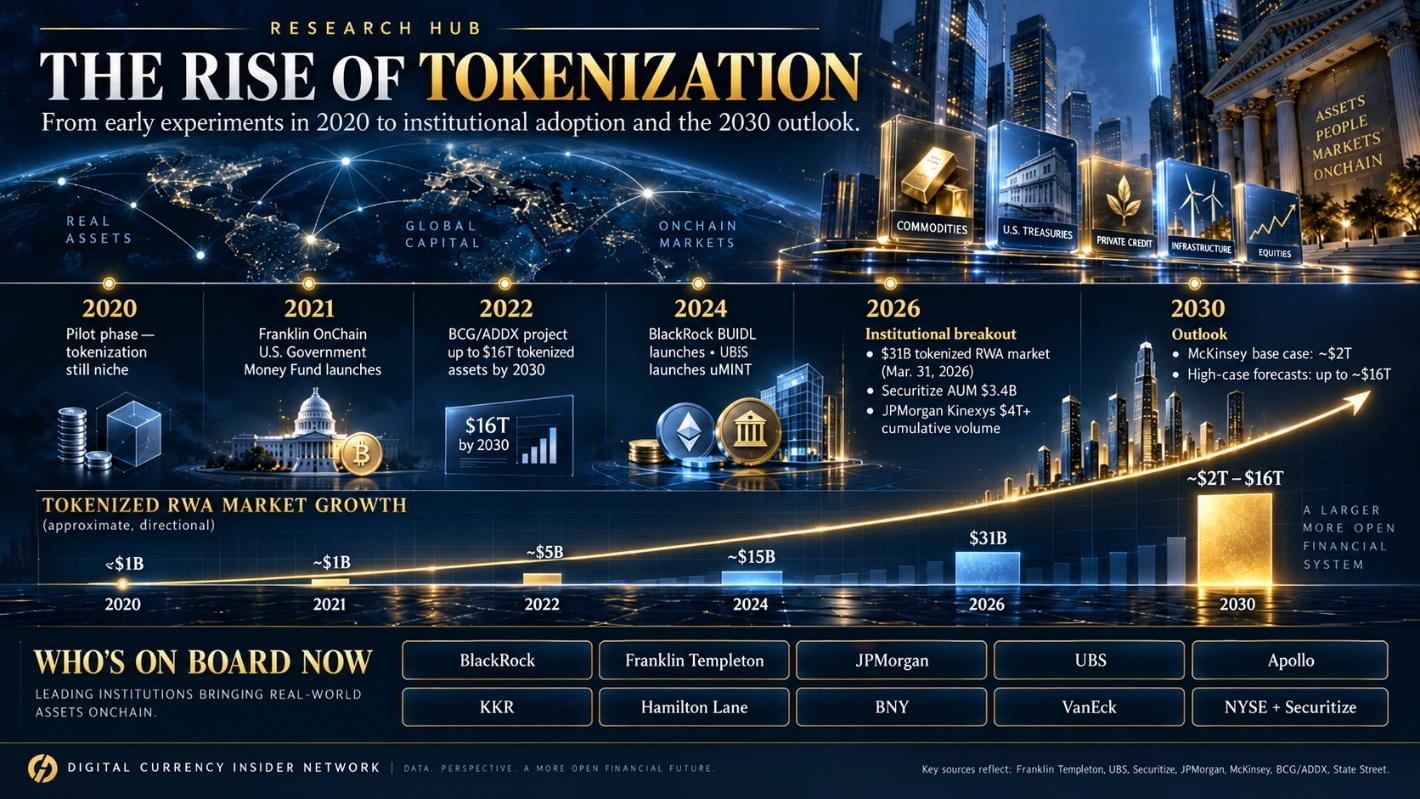
Measured narrowly, the market is still small compared with the hundreds of trillions of dollars represented by global securities, real estate, credit and commodities. Securitize, citing RWA.xyz data, reported that the tokenized real-world-asset market grew from approximately $23 billion at the end of 2025 to $31 billion by March 31, 2026—a roughly 35% increase in one quarter. But the significance of tokenization may lie less in today's absolute market value than in the institutions now building the infrastructure. The question has shifted from:
"Will traditional assets move on-chain?"
to:
"How much of the financial system will eventually operate on tokenized infrastructure?"
Forecasts differ dramatically. McKinsey estimates approximately $2 trillion of tokenized assets by 2030 in its base case, excluding cryptocurrencies and stablecoins, with an optimistic scenario around $4 trillion.
BCG's 2026 analysis is considerably more aggressive, estimating roughly $14 trillion of tokenized real-world assets by 2030 in its middle-of-the-road scenario and $55 trillion by 2035.
An earlier BCG/ADDX study projected approximately $16.1 trillion of tokenized illiquid assets by 2030, equivalent to roughly 10% of projected global GDP under that study's methodology. Those numbers should not be treated as interchangeable forecasts. They use different definitions and assumptions. But they point toward the same conclusion:
Tokenization is no longer being studied as a niche crypto application. It is increasingly being evaluated as a new infrastructure layer for global finance.
2020: Tokenization Was Still an Experiment
To understand how quickly the market has changed, return to 2020.
Bitcoin was widely known.; Ethereum had established itself as a programmable blockchain.; Stablecoins were growing.; Decentralized finance was emerging.
But the idea that major asset managers would place regulated investment funds, government securities and institutional financial products onto blockchain networks was still far from mainstream. "Security tokens" were discussed extensively, but adoption remained fragmented.
Early projects concentrated on concepts such as:
fractional real estate; private securities; digital bonds; artwork and collectibles; commodity-backed tokens; private-company shares; and; blockchain-based ownership records.
There was no universally accepted measurement for the tokenization market. That remains important today. Unlike the public-equity market, where market capitalization can be calculated consistently, "tokenized assets" can refer to very different things.
Some measurements include stablecoins.; Others exclude them.; Some count private credit.; Others count only directly issued blockchain securities.; Some include tokenized commodities.; Some include tokenized deposits and repo transactions.
Some studies estimate the value of assets represented on-chain, while others measure transaction volume moving through tokenized financial infrastructure. Consequently, the early tokenization market is better characterized as a collection of pilots and emerging platforms than by a single reliable 2020 market-cap figure. But the foundation was being built.
2021: Traditional Investment Funds Move On-Chain
A major milestone came in 2021. Franklin Templeton launched the Franklin On Chain U.S. Government Money Fund on April 6, 2021. The fund invests principally in U.S. government securities, cash and fully collateralized repurchase agreements. By July 31, 2026, Franklin reported approximately $720.9 million in net assets. Its significance went beyond the size of the fund. Here was a traditional regulated asset manager integrating blockchain infrastructure into an established investment product. The distinction was fundamental. Tokenization was no longer simply about creating new crypto assets. Blockchain was beginning to become a new recordkeeping and distribution layer for conventional financial assets.
2022: Wall Street Begins Taking Tokenization Seriously
By 2022, institutional thinking started to change. The crypto market itself was entering a severe downturn, but something interesting happened underneath the collapse:
Institutional tokenization development continued.
BCG and ADDX published one of the decade's most influential forecasts, estimating that tokenization of illiquid assets could represent approximately $16.1 trillion by 2030. The study envisioned tokenization expanding across:
real estate; investment funds; bonds; listed and private equity; infrastructure; alternative investments; patents; vehicle fleets; and; other financial and physical assets.
At the time, the projection looked extraordinarily ambitious. But it changed the conversation. Instead of asking whether tokenization could create a new niche investment market, researchers began asking whether tokenization could eventually represent a meaningful percentage of the world's assets.
2023: Tokenization Separates From "Crypto"
The year 2023 represented another important transition. The institutional narrative increasingly separated blockchain technology from speculative cryptocurrencies. Banks and asset managers started focusing on specific use cases where distributed ledgers could produce measurable benefits:
Digital bonds; Repo transactions; Tokenized deposits; Private-market funds; Collateral management; Cross-border settlement; Money-market instruments; Programmable payments
McKinsey observed in 2023 that the narrative in financial services was moving back toward "blockchain, not crypto." The firm pointed to production systems already processing substantial institutional transaction volumes, including blockchain-based repo infrastructure.
The distinction would become increasingly important.; Bitcoin demonstrated decentralized digital scarcity.; Stablecoins demonstrated blockchain-based money.
Tokenization was beginning to demonstrate something different: Blockchain-based ownership and settlement of traditional financial assets.
2024: BlackRock Changes the Conversation
Then came BlackRock. In March 2024, the world's largest asset manager launched the BlackRock USD Institutional Digital Liquidity Fund—BUIDL. For institutional tokenization, the psychological importance of that development was enormous. BlackRock was not a blockchain startup trying to convince Wall Street that tokenization mattered. BlackRock was Wall Street.
The fund placed institutional money-market exposure onto blockchain infrastructure through Securitize. That same year UBS Asset Management launched uMINT, its first tokenized investment fund, a money-market investment built on Ethereum. UBS said it was responding to growing investor appetite for tokenized financial assets. The era of demonstrations was beginning to give way to actual products.
2025–2026: Institutional Adoption Accelerates
The market entered another stage during 2025 and 2026.; Tokenized U.S. Treasuries expanded.; Private-credit products moved on-chain.; Tokenized money-market funds grew.; Commodity tokens expanded.; Banks increased development of tokenized deposits.; Asset managers began building tokenized versions of existing investment products.
And infrastructure providers started connecting traditional regulated markets with public blockchain networks. Securitize provides one useful window into that growth. Its SEC filings show average tokenized assets under management increasing from roughly $200 million in the first half of 2023 to approximately $3.9 billion in the second half of 2025 - a reported compound annual growth rate of about 173%. By March 31, 2026, Securitize reported $3.4 billion in tokenized AUM, $24.9 billion in assets under administration and $1.9 billion of quarterly transaction volume. At the broader market level, Securitize cited RWA.xyz data showing tokenized RWAs rising from approximately $23 billion on December 31, 2025 to $31 billion on March 31, 2026. That is still tiny relative to global capital markets. But the direction of travel is unmistakable.
Who Is On Board Now?
Perhaps the biggest difference between 2020 and 2026 is not market capitalization. It is the names involved. Six years ago, tokenization was driven primarily by blockchain startups, fintech entrepreneurs and specialist digital-asset firms. Today the ecosystem includes some of the largest institutions in global finance.
BlackRock
BlackRock's BUIDL fund has become one of the flagship examples of institutional tokenization and helped establish tokenized Treasury and liquidity products as a serious asset-management category.
Franklin Templeton
Franklin Templeton's On-Chain U.S. Government Money Fund traces its inception to 2021 and demonstrates that regulated funds can incorporate blockchain infrastructure within conventional asset-management structures.
JPMorgan
JPMorgan has developed extensive blockchain infrastructure through Kinexys, spanning payments, tokenized assets and institutional settlement. The importance of JPMorgan's participation is broader than any individual token. The institution is helping demonstrate that blockchain can function as banking infrastructure, not merely a venue for cryptocurrencies.
UBS
UBS Tokenize now supports digital-asset activity across bonds, funds and structured products. UBS reports that its work dates back to proofs of concept between 2019 and 2021, followed by a $50 million tokenized fixed-rate note pilot in 2022, production tokenized products in 2023 and its tokenized uMINT investment fund in 2024.
Apollo, KKR, Hamilton Lane, BNY and VanEck
These institutions have participated in tokenized products through infrastructure providers including Securitize. An SEC filing from Securitize states that by the end of 2025 the company had more than $3.1 billion of tokenized AUM through partnerships involving Apollo, BlackRock, BNY, Hamilton Lane, KKR and VanEck.
The New York Stock Exchange
Perhaps even more significant is the movement of traditional market infrastructure. In 2026, the NYSE and Securitize announced a collaboration aimed at supporting tokenized securities markets, with Securitize designated as a design partner for an upcoming NYSE-affiliated digital trading platform. Tokenization is consequently moving beyond issuers.
The exchanges themselves are preparing.
Institutional Adoption Is No Longer Hypothetical
Survey data reinforces that shift. State Street's October 2026 global study of 300 asset managers, asset owners and wealth managers found:
35% already manage or distribute digital assets.; Another 28% have the infrastructure and provider relationships necessary to do so when client demand arises.; 51% expect digital assets to become mainstream within five years if they have not already.; And 84% of surveyed institutions planning product development indicated plans for tokenized versions of existing products.; That does not mean 84% of the world's assets are about to become tokenized.
It does mean something important:
Institutional participation is moving from experimentation toward implementation.
Why Tokenize an Asset at All?
Tokenization alone does not make an asset more valuable.; Putting a building on a blockchain does not make the building taller.; Tokenizing a Treasury bill does not change the U.S. government's obligation to repay it.; The value proposition lies instead in changing how ownership is recorded, transferred and administered.
Potential benefits include:
Fractionalization
A large asset can potentially be divided into smaller economic interests.
24/7 infrastructure Blockchain systems do not inherently depend on conventional banking hours.
Faster settlement Ownership and payment can potentially move much closer together.
Programmability Smart contracts can automate distributions, restrictions, interest payments, redemptions and corporate actions.
Transparency Authorized participants can potentially see ownership, transaction histories and asset data more efficiently.
Collateral mobility Tokenized assets can potentially move between financial applications more rapidly.
Global distribution Digital infrastructure can reduce some geographical and technological barriers to investment—subject, critically, to securities laws and investor eligibility.
But perhaps the greatest benefit could eventually be interoperability. A tokenized Treasury, tokenized bank deposit and tokenized investment fund could theoretically transact across compatible infrastructure without the layers of reconciliation required by today's fragmented financial system.
The Market Is Still Small - and That Matters
A credible analysis of tokenization must acknowledge something the industry's promotional material sometimes overlooks.
Tokenization is not yet a multi-trillion-dollar RWA market today.
Measured on-chain RWA markets excluding large categories such as stablecoins and some institutional settlement activity remain comparatively small. BCG stated in 2026 that tokenized RWAs excluding stablecoins and repos remained below $25 billion under its particular market definition, even while tokenized Treasury and repo activity had reached much greater scale. Other datasets produce higher totals because they use broader classifications. This explains why market-size claims can appear contradictory. The number depends heavily on whether a researcher counts:
Stablecoins,; tokenized deposits,; repo transactions,; public securities,; private credit,; commodities,; real estate,; funds,; blockchain-native assets; or; only assets legally representing off-chain property.
For the DCIN Research Hub, this distinction will matter.
Market definitions should always accompany market numbers.
From $31 Billion to Trillions?
This is the central question for the remainder of the decade.; There is no single accepted 2030 forecast.; Instead, there is an extraordinary range.
McKinsey: Approximately $2 Trillion
McKinsey's base-case forecast calls for approximately $2 trillion of tokenized market capitalization by 2030, excluding cryptocurrencies and stablecoins. Its optimistic scenario reaches approximately $4 trillion. McKinsey expects early scale particularly in mutual funds, bonds, exchange-traded notes, loans and securitization.
BCG/ADDX: Approximately $16 Trillion
BCG and ADDX's influential 2022 research estimated $16.1 trillion of tokenized illiquid assets by 2030, with the opportunity spanning equities, bonds, investment funds, home equity and other tokenizable physical and financial assets.
BCG 2026: Approximately $14 Trillion
Importantly, BCG's newer 2026 research still sees a very large opportunity, estimating roughly $14 trillion of tokenized RWAs by 2030 in its middle scenario and approximately $55 trillion by 2035.
The range is enormous.
And that is precisely what investors should expect from an emerging market whose boundaries have not yet been standardized.
DCIN Research Hub: A More Useful Way to Read the Forecasts
Rather than declaring that tokenization “will be worth $16 trillion by 2030,” we believe it is more useful to interpret the projections as scenarios.
Conservative institutionalization
Approximately $1–$2 trillion Tokenization becomes significant in funds, government securities, private credit and selected institutional markets but does not broadly replace existing infrastructure.
Broad institutional adoption
Approximately $4–$10 trillion. Tokenization spreads across funds, fixed income, deposits, private markets, commodities and selected equities while regulated on-chain settlement becomes increasingly commonplace.
Tokenization breakout
Approximately $14–$16+ trillion. Tokenized infrastructure expands well beyond financial securities into real estate, infrastructure, alternative investments, commodities and corporate assets, while interoperability and regulatory frameworks mature rapidly.
The difference between those scenarios will depend on much more than blockchain technology.
It will depend on law.
Custody.; Identity.; Liquidity.; Settlement.; Interoperability.; Regulation.; Investor demand.
And whether tokenized assets can actually trade efficiently after issuance.
The Next Breakthrough Is Not Token Creation
Creating a token is easy.; Creating a liquid, legally enforceable, institutionally trusted market is difficult.; That will define the second half of the decade.; A successful tokenized asset needs more than a smart contract.
It requires: A legally recognized underlying asset Clear ownership rights Reliable custody Independent valuation KYC and AML controls Transfer restrictions where required Trusted data and oracles A compliant marketplace A settlement asset Secondary-market liquidity Interoperability with existing financial institutions Without those layers, tokenization is merely digitization. With them, it becomes financial infrastructure.
DCIN RESEARCH HUB | KEY FINDING
The most important change since 2020 is not the number of tokens in circulation. It is the migration of tokenization from blockchain startups into the balance sheets, products and infrastructure of the world's largest financial institutions.
2030 May Be a Beginning, Not an Endpoint
The most compelling argument for tokenization is therefore not that every asset will suddenly appear on-chain by December 31, 2030. It is that the infrastructure being created this decade could establish the rails upon which assets increasingly move during the next. The internet did not replace global communications overnight. Electronic trading did not eliminate trading floors overnight. ETFs did not replace traditional investment funds overnight.
Financial infrastructure evolves gradually - until network effects make the new architecture difficult to ignore.
Tokenization may follow the same pattern.; First came cryptocurrency.; Then stablecoins.; Then tokenized Treasuries.; Then money-market funds.; Then private credit.; Then bonds, commodities and investment funds.
Next may come equities, real estate, infrastructure, natural resources and increasingly sophisticated financial instruments. And eventually the distinction between a "tokenized asset" and a conventional financial asset may begin to disappear.
The asset will simply be digital from issuance.; Ownership will be programmable.; Compliance will travel with the asset.; Cash and securities will settle together.; Markets may operate continuously.
And investors may interact with financial instruments across borders through infrastructure radically different from the databases and reconciliation systems built during the twentieth century.
The Bottom Line
In 2020, tokenization was largely a thesis.; In 2021, regulated investment products began proving the architecture.; By 2022 and 2023, banks and institutional researchers were taking the market seriously.; In 2024, BlackRock and UBS helped move tokenization decisively into mainstream asset management.
By 2025 and 2026, tokenized Treasuries, funds, private credit, deposits and institutional settlement infrastructure had begun establishing measurable markets. Today, the tokenized RWA market remains small relative to global finance. But its participants no longer are.
BlackRock.; JPMorgan.; Franklin Templeton.; UBS.; BNY.; Apollo.; KKR.; Hamilton Lane.; VanEck.; State Street.
NYSE.
And an expanding ecosystem of banks, exchanges, custodians, asset managers and blockchain infrastructure providers. That may be the most important data point of all. The first half of this decade was about proving that assets could be tokenized.
The second half will determine whether tokenization becomes a meaningful component of the world's financial infrastructure.
By 2030, estimates range from roughly $2 trillion at the more conservative institutional end to approximately $14–$16 trillion under broader adoption scenarios. Whether the eventual number lands near the bottom, middle or top of that range, the direction is becoming increasingly difficult to dispute.
Capital markets are moving on-chain.
And the race to build the infrastructure has already begun.
RESEARCH HUB METHODOLOGY NOTE
There is currently no universally accepted definition of the “tokenization market.” Market estimates can differ substantially depending on whether calculations include or exclude stablecoins, tokenized deposits, repos, cryptocurrencies, commodities and other asset categories. DCIN therefore distinguishes observed market values from forecasts and identifies the methodology or exclusions behind major projections whenever possible.
DCIN RESEARCH HUB
Data • Markets • Tokenization • Digital Finance • Institutional Adoption
The Digital Currency Insider Network Research Hub examines the data, infrastructure, institutions and technologies shaping the transition toward digital capital markets.
Sources & attribution
Digital Currency Insider Network - Research Hub · October 21, 2026