DCIN INSIGHT | TOKENIZATION & REAL-WORLD ASSETS · 21 OCTOBER 2026
Not All Tokens Are Created Equal
Understanding the Token Standards Building the New Real-World Asset Economy
Digital Currency Insider Network · Schad Brannon - Editorial Team · October 21, 2026
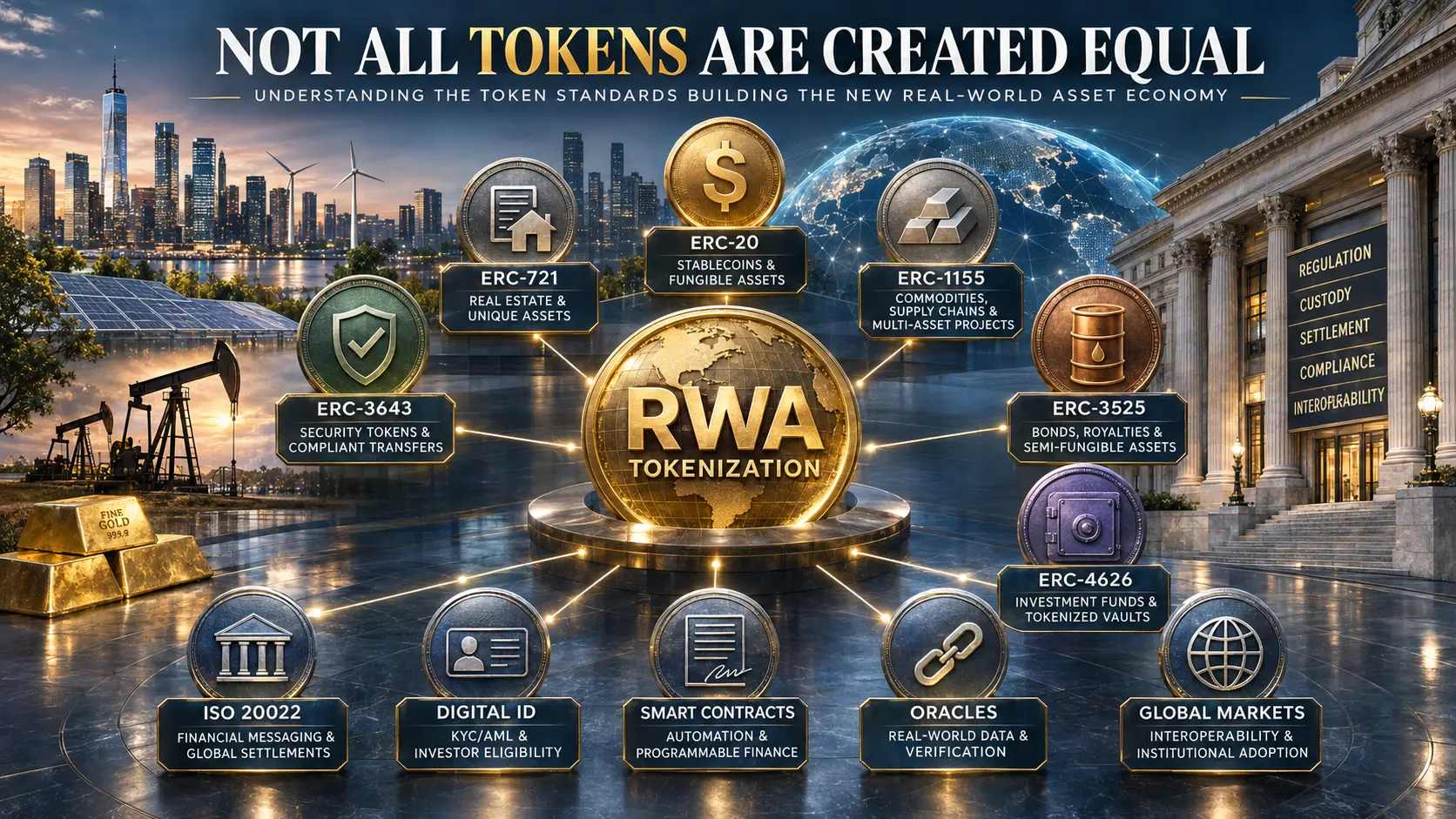
The emerging tokenized economy is being built from multiple technical, identity, compliance, settlement and financial-messaging standards—not one universal token format.
The word token has become one of the most frequently used - and frequently misunderstood - terms in digital finance.
• A token can represent a dollar. • It can represent one ounce of gold. • It can represent one share of a company.
• It can represent a fractional interest in a bond.
It can represent an oil-production entitlement, warehouse receipt, investment-fund share, real-estate interest, carbon credit, royalty stream or unique title to a physical asset. Those instruments should not necessarily be built the same way.
As the financial industry moves deeper into Real World Asset (RWA) tokenization, the distinction between different token standards is becoming increasingly important. The future of tokenization will not be built around a single universal token. It will be built around a stack of interoperable standards, with each standard performing a different financial function. That distinction matters because the token itself is only one piece of the architecture. A serious RWA project may need standards governing:
• ownership; • fungibility; • transferability; • investor identity; • KYC and AML compliance; • securities restrictions; • custody; • settlement; • asset valuation; • legal documentation; • corporate actions; • financial messaging; and • redemption of the digital instrument for the underlying asset.
Understanding those layers is becoming essential for anyone entering the tokenized economy.
ERC-20: The Foundation of Fungible Tokenization
The best-known Ethereum token standard is ERC-20. ERC-20 establishes a common interface for fungible tokens—assets where one unit is intended to be interchangeable with another unit of the same class. Ethereum's specification describes ERC-20 as a standardized token interface that includes basic functions such as balances, transfers and approvals. That makes ERC-20 a natural starting point for assets such as:
• Stablecoins If every digital dollar represents the same economic value, fungibility makes sense. • Commodity units If every token represents one gram of gold meeting the same specification, the units may be interchangeable.
• Fund interests Identical fractional units of an investment pool can potentially be represented as fungible tokens. • Debt participation A uniform class of notes or debt interests could potentially use a fungible structure. • Fractional ownership One commercial property, mineral project or infrastructure asset might theoretically be divided into one million equal economic interests.
ERC-20's simplicity helped make it enormously successful. But simplicity also creates a limitation. A conventional ERC-20 token does not inherently know whether its holder passed KYC. It does not inherently know whether the investor is accredited. It does not automatically know whether the holder resides in a restricted jurisdiction. And it does not determine whether a transfer violates securities law. That is why representing an asset and regulating an asset are two different problems.
ERC-721: When Every Asset Is Unique
ERC-721 introduced the modern non-fungible token, or NFT. While NFTs became famous through digital art and collectibles, the underlying standard has much broader potential. Ethereum's ERC-721 specification specifically contemplated the tracking of distinguishable real-world assets, including real estate. That makes ERC-721 particularly interesting for RWAs where individual assets cannot simply be mixed together. Consider:
A property deed • 123 Main Street is not interchangeable with 125 Main Street.
A vehicle title • A truck with VIN A is not identical to a truck with VIN B.
A specific gold bar • A London Good Delivery bar can have its own serial number, weight, refinery and assay record.
A piece of equipment • A drilling rig, aircraft engine or excavator has a unique serial number, maintenance history and condition.
A mineral concession
• One concession can have completely different geology, geography and legal rights from another. ERC-721 therefore becomes useful when the blockchain needs to answer the question:
Which specific asset does this token correspond to?
That makes the standard potentially useful for digital titles, certificates and asset registries. But ownership of the NFT does not automatically mean legal ownership of the physical property. The legal documents governing the token must establish that connection. That distinction is critical.
ERC-1155: One Contract, Many Types of Assets
ERC-1155 was designed to support multiple token types within one smart contract. Unlike ERC-20, which is built primarily around fungible units, or ERC-721, which represents unique units, ERC-1155 can support combinations of fungible, non-fungible and semi-fungible assets within the same architecture. This creates interesting possibilities for complex RWA projects. Imagine tokenizing an oil operation. One ERC-1155 architecture could theoretically represent:
• oil-production units; • equipment certificates; • royalty classes; • drilling rights; • carbon credits; and • other project-specific digital interests.
Or consider a commodity warehouse. Different token IDs might represent:
• Grade A copper; • Grade B copper; • gold; • silver; • cobalt; and • individual warehouse lots.
ERC-1155 also supports batch transfers, which can make the management of multiple asset classes more efficient. For complicated commodity ecosystems, supply chains and multi-asset projects, that flexibility can be extremely valuable.
ERC-3525: The Important Middle Ground - Semi-Fungible Assets
Financial assets are not always completely fungible or completely unique. That is where ERC-3525 becomes particularly interesting. ERC-3525 introduced the concept of the semi-fungible token. The standard combines an individual token identity with both a "slot" and a numerical value. Tokens belonging to the same slot can share fungible characteristics while each individual token can still maintain its own identity. This structure maps surprisingly well compared to traditional finance. Consider bonds. Two investors might each own part of the same bond series.
The bonds share: • the same issuer; • maturity; • coupon; • seniority; and • governing terms. • Yet each investor's position may have a different quantity. • ERC-3525 can conceptually accommodate that distinction. • Potential RWA applications include:
Bonds • Different bond series can occupy different slots while individual positions contain different values.
Private credit • Loans with common terms could potentially be grouped while retaining individual ownership records.
Structured products • Different tranches could have separate characteristics.
Vesting or royalty interests • Rights can remain distinguishable while still carrying measurable economic values.
Commodity contracts • Specific contract classes could be identified while quantities remain divisible. For financial engineering, semi-fungibility may ultimately become one of the most important concepts in tokenization.
ERC-3643: When the Asset Must Know Who Is Allowed to Own It
Once tokenization enters the world of regulated securities, unrestricted transfers become a problem. A tokenized security cannot always be sent freely from Wallet A to Wallet B. There may be rules concerning: • KYC; • AML; • investor accreditation; • jurisdiction; • ownership limits; • lock-up periods; • sanctions;
• transfer restrictions; and • regulatory eligibility.
ERC-3643, also known as T-REX - Token for Regulated Exchanges—was designed specifically to address this problem. ERC-3643 is now a finalized Ethereum standard for permissioned securities. It is ERC-20 compatible but adds identity registries and compliance controls so transfers can occur only when applicable eligibility and offering rules are satisfied. The architecture can also support functions expected in regulated finance, including: • identity verification; • transfer pre-checks; • freezing; • token recovery; • minting and burning; • forced transfers; • compliance modules; and • authorized issuer or agent roles.
This is a fundamental evolution. Traditional cryptocurrencies generally ask: • Does this wallet possess the token? A regulated token may also need to ask: • Is the person behind this wallet legally permitted to possess this token? ERC-3643 brings that distinction into the token architecture itself. For that reason, permissioned standards are particularly important for: • tokenized securities; • private equity; • private credit; • regulated investment funds; • institutional real estate; • tokenized bonds; and • certain sovereign or infrastructure investments.
The ERC-3643 Association has also launched an initiative seeking international ISO standardization of the permissioned-token framework, demonstrating how blockchain-native standards and traditional institutional standards are beginning to converge.
ERC-1400: An Important Security-Token Architecture
Another influential name in regulated tokenization is ERC-1400. Rather than thinking of ERC-1400 simply as another cryptocurrency format, it is better understood as a collection of concepts developed specifically for security tokens. Its architecture addressed issues such as: • transfer restrictions; • partitioned ownership; • issuance and redemption;
• legal-document references; • controller operations; and • securities administration.
The ERC-1400 family helped establish many of the concepts now considered necessary for institutional security tokenization. It should, however, be distinguished from finalized standards such as ERC-3643. Some of the ERC-1400 family developed as proposed security-token interfaces rather than becoming universally adopted final Ethereum standards.
That distinction matters. A technology being called a token standard does not necessarily mean it has the same status, adoption or governance as every other ERC.
ERC-4626: Turning Investment Vaults into Standardized Tokens
ERC-4626 solves a different problem. It standardizes tokenized vaults.
An ERC-4626 vault accepts an underlying ERC-20 asset and issues shares representing a proportional claim on the assets held by the vault. Ethereum describes it as a standard API for tokenized vaults with a single underlying ERC-20 asset. This can become particularly important as traditional funds migrate on-chain.
• Imagine a tokenized Treasury fund. • Investors deposit an eligible digital settlement asset. • The vault acquires or represents underlying Treasury exposure. • Investors receive tokenized shares. • The number of underlying assets attributable to each share can change as income accrues.
That model can potentially be adapted for: • money-market funds; • Treasury products; • private-credit pools; • lending structures; • commodity pools; • yield-bearing stable assets; and • tokenized investment vehicles.
ERC-4626 illustrates an important point about financial tokenization: • Sometimes the token does not represent the underlying asset directly. • It represents a share of a vehicle that owns the underlying asset. • Traditional finance already works this way. • You do not physically own the individual Treasury securities inside a mutual fund. • You own shares of the fund. • Tokenization can recreate—and potentially automate—that structure.
One Asset Can Require More Than One Standard
This is where RWA tokenization becomes particularly sophisticated. Suppose a government wants to tokenize a $500 million infrastructure project. The project might involve several different token standards simultaneously.
• An ERC-721 token might represent the unique project asset or title. • An ERC-20 instrument could represent fractional economic interests. • An ERC-3643 layer could restrict those interests to eligible investors. • An ERC-4626 structure could represent an investment pool holding project assets.
Digital identity credentials could establish investor eligibility. External oracles could provide project valuations and operating data. ISO 20022 messages could connect the blockchain system to banking and payment infrastructure. Legal agreements would define what the token holder actually owns. The result is not one token. It is a financial technology stack.
Technical Standards Are Not Legal Standards
This may be the single most important distinction in RWA tokenization. An ERC designation tells software how a digital instrument behaves. It does not, by itself, determine what the token legally represents. An ERC-20 token could represent:
• nothing; • a loyalty point; • a stablecoin; • a security; • an ounce of gold; • a debt obligation; or • an economic interest in an oil project.
The smart contract alone does not answer the legal question. The enforceable relationship between the digital token and the real-world asset usually depends upon another layer of documentation. That can include:
• Property law Who owns the underlying asset? • Corporate law Which entity issued the token? • Securities law Does the token constitute a security?
• Contract law What contractual rights does the token holder receive? • Custody agreements Who physically controls the underlying commodity or security? • Trust or SPV documentation Is the underlying asset bankruptcy remote? • Offering documents What exactly was promised to investors? • Redemption agreements Can the digital token actually be exchanged for the underlying asset or cash?
The strongest RWA structure therefore requires the legal instrument and the digital instrument to acknowledge one another.
The Digital Token Needs a Financial Acknowledgment
This creates what DCIN believes will become an increasingly important concept in tokenization:
The Financial Acknowledgment Layer
A serious RWA token should answer several fundamental questions. • What asset does this token acknowledge? • Who legally owns that asset? • Who holds or controls it? • How has its existence been independently verified? • What rights does the token grant? • What happens when the asset generates income? • How is ownership transferred? • How is the token redeemed? • What happens if the issuer becomes insolvent? • Which jurisdiction's law governs the relationship?
Without those answers, tokenization can become little more than digitized speculation. With them, the blockchain can become an operating layer for real financial assets.
ISO 20022: The Financial Language Sitting Beside the Token
Another frequently misunderstood standard is ISO 20022.
ISO 20022 is not a cryptocurrency standard, and it does not make a blockchain or token automatically compliant with global banking. It is an international financial messaging framework prepared through ISO Technical Committee 68. Its purpose is to provide common business semantics, models and message structures that financial institutions and market infrastructures can use to communicate consistently. Its message catalogue covers areas including:
• payments; • securities; • cash management; • foreign exchange; • cards; • trade finance; and • financial-authority communications.
Why does that matter to tokenization? Because ultimately a tokenized asset may need to interact with the traditional financial system.
A blockchain might record:
• WHO OWNS THE ASSET
while ISO 20022 financial infrastructure communicates:
• WHO PAID WHOM, HOW MUCH, FOR WHAT, AND HOW THE TRANSACTION SHOULD BE RECONCILED.
These are complementary functions.
DCIN PULL QUOTE
“The blockchain may become the ownership ledger. ISO 20022 can remain part of the financial language through which banks, custodians and market infrastructures communicate.”
Institutional tokenization cannot depend solely upon wallet addresses.
A blockchain address such as:
0x7A...93F
does not inherently tell a financial institution whether the wallet belongs to:
• a bank; • an individual; • a pension fund; • an accredited investor;
• a corporation; • a sanctioned party; or • nobody who has been identified at all.
Institutional finance therefore requires an identity and credential layer. This is why regulated-token architectures are increasingly incorporated: • KYC/KYB credentials; • digital identity; • investor classifications; • jurisdictional information; • compliance attestations; and • trusted credential issuers.
ERC-3643, for example, specifically uses on-chain identity and signed attestations from trusted issuers to determine whether an investor is eligible to receive a regulated token. The future financial system may therefore contain two parallel identifiers:
• The wallet tells the blockchain where the asset resides. • The verified identity tells the financial system who is legally behind the wallet.
Oracles: Connecting the Token to Reality
There is another major problem. A blockchain can verify what occurred on the blockchain. It cannot independently know what happened in the physical world. If a token represents oil production, the blockchain does not inherently know how many barrels were produced yesterday.
If it represents gold, the blockchain does not inherently know whether the gold remains inside the vault. If it represents real estate, the blockchain does not inherently know whether the building was destroyed by fire. That information has to enter through trusted data systems commonly referred to as oracles. For RWA markets, these data feeds may ultimately provide:
• commodity prices; • reserve reports; • production figures; • NAV calculations; • interest rates; • FX rates; • asset valuations; • proof-of-reserves information; • shipping records; • warehouse inventories; and • corporate actions.
This means the credibility of an RWA token is only as strong as the credibility of the information connecting it to reality.
Proof of Reserve Is Not Proof of Ownership
This distinction deserves special attention. A platform may demonstrate that a commodity exists. That does not necessarily prove that token holders own it. Suppose an issuer tokenizes $100 million of gold. An auditor verifies that $100 million of gold bullion exists in a vault. Excellent. But investors still need to know:
• Who owns the gold? • Is it pledged to another lender? • Can creditors of the issuer reach it? • Is the gold held in trust? • Is each token legally redeemable? • Who has authority to release it? • What happens during bankruptcy?
Proof of reserve proves existence - Legal documentation establishes rights.
Sophisticated tokenization requires both.
The Emerging RWA Standards Stack
The future institutional RWA structure can therefore be thought of as several layers:
Layer 1 — The Real Asset • Gold. • Oil. • Real estate. • Treasuries. • Private credit. • Infrastructure. • Logistics • Equipment. • Agricultural commodities.
Layer 2 — Legal Recognition • Title. • Contract. • Security. • Note. • Trust. • SPV interest. • Warehouse receipt. • Royalty agreement.
Layer 3 — Verification • Audit. • Assay. • Reserve report. • Appraisal. • Production report. • NAV calculation. • Custodial confirmation.
Layer 4 — Digital Representation • ERC-20. • ERC-721. • ERC-1155. • ERC-3525. • ERC-3643. • ERC-4626.
Or another appropriate blockchain standard.
Layer 5 — Identity & Compliance • KYC. • KYB. • AML. • Sanctions screening. • Investor qualification. • Jurisdiction. • Transfer restrictions.
Layer 6 — Data & Oracles • Pricing. • NAV. • Production. • Interest. • Commodity inventories. • Corporate actions.
Layer 7 — Payments & Settlement • Stablecoins. • Tokenized deposits. • CBDCs where applicable. • Bank payments. • Delivery-versus-payment systems.
Layer 8 — Financial Messaging
ISO 20022 and other institutional communication standards connecting banks, custodians and market infrastructures.
There Will Not Be One Winning Token Standard
The financial industry sometimes discusses token standards as though one will eventually defeat all the others.
• That is unlikely. • Traditional finance does not use one financial instrument for everything. • A stock is not a bond. • A bond is not a warehouse receipt. • A warehouse receipt is not a property deed. • A property deed is not a bank deposit. • A bank deposit is not an investment fund. • Why should their digital representations all be identical?
The better question is:
Which standard most accurately reflects the legal and economic characteristics of the underlying asset? That is the foundation of intelligent token design.
From Tokenization to Digital Capital Markets
The first generation of blockchain created digital-native assets. The next generation is connecting blockchain to assets that already exist.
• Stocks. • Bonds. • Funds. • Real estate. • Gold. • Oil. • Private credit. • Infrastructure. • Commodities.
Eventually, potentially trillions of dollars of traditional assets could exist simultaneously in conventional databases and blockchain-based financial infrastructure. But institutional adoption will require more than putting a token on a blockchain.
It will require agreement between multiple worlds: • Technology must recognize the asset. • Law must recognize ownership. • Regulators must recognize the transaction. • Auditors must recognize the value. • Custodians must recognize the asset. • Banks must recognize the payment. • Investors must recognize their rights.
And those systems must be capable of communicating with one another. That is why standards matter.
The Token Is Becoming the Financial Instrument
The ultimate evolution of RWA tokenization is not simply creating digital representations of assets. It is creating financial instruments that are machine-readable, programmable and interoperable from inception.
• A tokenized bond could potentially understand its coupon schedule. • A tokenized security could understand who is legally eligible to receive it. • A tokenized fund could calculate the relationship between shares and underlying assets. • A tokenized commodity could carry provenance information. • A digital title could identify a unique physical asset. • A smart contract could automatically distribute royalties. • A compliant transfer could occur only after both ownership and investor eligibility are verified. • Settlement could occur nearly simultaneously with transfer of ownership. • And standardized financial messaging could communicate the resulting transaction to banks, custodians and market infrastructure. • That is considerably more powerful than digitizing a paper certificate. • It is the beginning of a new financial architecture.
DCIN PULL QUOTE
"Tokenization will not replace financial standards. It will force traditional financial standards and blockchain standards to begin speaking the same language."
The Bottom Line
The next phase of digital finance will not be defined simply by how many assets become tokenized. It will be defined by how well those tokens represent reality. The winning RWA projects will not necessarily be the projects with the most elaborate blockchain technology. They will be the projects that successfully connect:
Asset + Ownership + Law + Identity + Compliance + Data + Settlement + Financial Messaging into one coherent architecture.
• ERC-20 may represent fungible value. • ERC-721 may identify unique property. • ERC-1155 may manage complex asset classes. • ERC-3525 may bridge the gap between unique and divisible financial instruments. • ERC-3643 may embed regulatory permissions into securities. • ERC-4626 may standardize tokenized investment vaults. • ISO 20022 may help those new digital instruments communicate with the existing financial system. • And additional standards will continue to emerge. • The result will not be one universal token.
It will be an interoperable ecosystem of digital financial instruments; each designed around the economic and legal characteristics of the asset it represents.
• That is the real foundation of the RWA revolution.
DCIN EDITOR'S NOTE
Token standards are technical specifications, not legal classifications. Use of an ERC or other blockchain standards does not by itself determine whether an instrument is a security, establish legal ownership of an underlying asset, satisfy KYC/AML requirements, or guarantee regulatory compliance. RWA structures require appropriate legal, regulatory, accounting, custody and technical analysis for the jurisdictions and assets involved.
Digital Currency Insider Network | DCIN Digital Finance • Tokenization • Innovation • Global Markets
Sources & attribution
Digital Currency Insider Network · Schad Brannon - Editorial Team · October 21, 2026